


Choosing the best country to raise a family involves much more than comparing salaries or living costs. Parents often consider the quality of education, healthcare, safety, childcare, housing, family benefits, work-life balance, and opportunities for children. In 2026, several countries stand out because they combine strong public services with safe communities and supportive environments for families.
The right choice ultimately depends on your family’s priorities, budget, and preferred lifestyle. Some countries offer excellent schools and healthcare, while others provide generous parental benefits, affordable housing, or a relaxed pace of life. Comparing these factors together can help families identify destinations where children can grow up with access to education, healthcare, recreation, and a good overall quality of life.
Trending today : Tax-Free Countries in 2026: a Global Overview
Why Family-Friendly Countries Matter (Criteria for 2026)
A family-friendly country can make a significant difference in how easily parents manage everyday life and how children grow and develop. Families need more than employment opportunities or attractive salaries. They also need safe neighborhoods, reliable schools, accessible healthcare, suitable housing, childcare options, and places where children can play and socialize. When these services are available and affordable, parents can spend less time dealing with financial and practical pressures and more time supporting their children’s education and well-being.
Education is one of the most important criteria when comparing countries in 2026. Families often look for high-quality schools, reasonable education costs, qualified teachers, and opportunities for children to continue into higher education. Access to early childhood education and affordable childcare can also be important for working parents. Countries that provide strong public education systems can reduce the financial burden on families while giving children a better foundation for the future.
Healthcare is another major consideration. Family-friendly countries should provide accessible medical services for children and adults, including preventive care, vaccinations, emergency treatment, and specialist services. The cost of healthcare also matters because unexpected medical expenses can place considerable pressure on a household budget.
Safety and stability are equally important. Parents generally want children to grow up in communities with low crime, dependable public services, political stability, and safe transportation. A country’s environmental quality, including clean air and access to parks and outdoor spaces, can also influence family life.
Work-life balance and family support help determine how practical a country is for parents. Paid parental leave, childcare assistance, flexible working arrangements, and family allowances can make it easier to combine employment with raising children. Housing affordability should also be considered because larger homes and suitable neighborhoods can be expensive in major cities.
Finally, overall affordability and quality of life bring these factors together. The best family-friendly countries in 2026 are not necessarily the richest nations; they are places where families can reasonably access essential services while maintaining a comfortable, secure, and balanced lifestyle.
Top 10 Countries to Raise a Family in 2026
Choosing a country for family life requires looking beyond income and economic strength. Parents typically consider children’s safety, education, healthcare, childcare, housing, parental support, work-life balance, and access to parks and recreational activities. The following countries stand out in 2026 because they combine strong public services with family-oriented policies and generally high living standards.
1. Sweden
Sweden is widely regarded as a strong place to raise children because of its generous family policies, high-quality public services, and emphasis on work-life balance. Parents benefit from an extensive parental leave system that allows families considerable flexibility during a child’s early years. The country also provides subsidized childcare, helping parents return to work without facing the full cost of private daycare.
Education is another major advantage. Sweden provides publicly funded schooling and places considerable emphasis on children’s independence, creativity, and overall development. Families also have access to well-developed healthcare services, including child health programs and preventive care.
Swedish cities provide clean public spaces, playgrounds, libraries, sports facilities, and easy access to nature. Stockholm, Gothenburg, and Malmö offer extensive services, although housing can be expensive. Smaller cities and towns may provide a quieter family environment and more manageable accommodation costs.
The main drawback is the relatively high overall cost of living. Taxes can also be substantial, but these contribute toward public services and social benefits. For families who prioritize education, social support, safety, and work-life balance over extremely low living costs, Sweden remains one of Europe’s strongest choices.
2. Denmark
Denmark offers a combination of excellent public services, family support, safety, and a strong work-life balance. Danish society places considerable value on spending time with family, and parents generally benefit from policies designed to make employment and childcare easier to combine.
Childcare is widely available and supported through public funding, reducing the financial burden compared with relying entirely on private services. Education is also highly accessible, and children grow up with opportunities to participate in sports, cultural activities, libraries, and community programs.
Copenhagen is particularly attractive for families because of its cycling infrastructure, public transportation, parks, schools, and family-oriented neighborhoods. Other cities and smaller communities can offer a quieter lifestyle with less pressure from housing costs.
Denmark is not a cheap country. Food, housing, services, and taxes can be relatively high compared with many countries in Eastern Europe. However, families often receive substantial value through public services. For parents who can manage the higher expenses, Denmark offers a stable and child-friendly environment with a strong emphasis on equality and quality of life.
3. Norway
Norway is another excellent option for families seeking safety, nature, high-quality public services, and a comfortable standard of living. Its extensive welfare system supports families through healthcare, education, childcare arrangements, and parental benefits.
Children have access to publicly funded education, while healthcare services are designed to provide broad access to residents. Norway also provides an environment where outdoor activities are a major part of everyday life. Mountains, forests, lakes, and coastal areas give families plenty of opportunities for hiking, skiing, cycling, and other activities.
Oslo offers modern schools, transportation, healthcare, cultural attractions, and employment opportunities. Families who prefer a smaller community can choose towns outside the capital, where access to nature is often even better.
The major disadvantage is cost. Norway has relatively high prices for housing, restaurants, groceries, and many services. Families moving there should therefore have sufficient income or financial resources. Nevertheless, the country’s combination of economic stability, safety, family support, and outdoor lifestyle makes it a compelling choice for raising children.
4. Netherlands
The Netherlands is particularly appealing to families because of its excellent infrastructure, cycling culture, education system, and family-friendly urban design. Children can often travel independently as they grow older because many communities have safe cycling routes and reliable public transportation.
Dutch cities provide access to schools, healthcare facilities, parks, libraries, sports clubs, and cultural activities. Amsterdam is internationally connected and offers many opportunities, although its housing market can be challenging. Cities such as Utrecht, Eindhoven, Groningen, and Rotterdam provide alternatives with different lifestyles and housing options.
The country also has a strong reputation for balancing professional and family life. Flexible working arrangements are relatively common, allowing parents to spend more time with their children.
The Netherlands does have high housing costs, particularly in popular cities. Families should carefully compare rent and property prices before choosing a location. Despite this challenge, its infrastructure, education, safety, and child-centered public spaces make it one of the most practical countries for families.
5. Canada
Canada combines large cities, excellent natural environments, multicultural communities, and strong educational opportunities. Families can choose between major metropolitan areas and smaller communities depending on their priorities and budget.
Canadian public schools provide broad access to education, while universities and colleges offer numerous pathways for older children. Healthcare is publicly funded for eligible residents, although waiting times and access to some services can vary between provinces.
Cities such as Calgary, Ottawa, Edmonton, Vancouver, Toronto, and Montreal offer different advantages. Families should be aware that housing costs can vary enormously. Toronto and Vancouver, for example, can be particularly expensive, while other cities may offer better value.
Canada’s natural environment is another major advantage. Families can enjoy national parks, lakes, forests, mountains, and extensive recreational facilities. Its multicultural population can also make it easier for international families to find diverse communities.
The main challenges include housing affordability in certain metropolitan areas, long winters in many regions, and the distance between major population centers. Overall, Canada remains attractive for families who value education, nature, cultural diversity, and long-term opportunities.
6. Finland
Finland is well known for its education system, social support, safety, and child-focused approach. Families benefit from accessible public services and an environment that encourages children to learn, explore, and develop independence.
Finnish education places strong emphasis on equality and student well-being rather than relying solely on intense academic competition. Public schools provide high-quality education, while children also have access to libraries, sports facilities, parks, and outdoor spaces.
Healthcare and family services are another important strength. Parents can access public services designed to support children’s health and development. Finland’s parental and childcare policies also help families balance employment and raising children.
Helsinki provides the widest range of jobs, schools, cultural attractions, and international connections. Smaller cities can offer lower housing costs and a quieter environment. The country’s cold and dark winters may be challenging for some families, particularly those accustomed to warmer climates.
Although Finland is not among Europe’s cheapest destinations, its strong public services can offset some household expenses. Families looking for education, safety, nature, and social stability may find Finland particularly attractive.
7. Switzerland
Switzerland offers an exceptionally high standard of living, excellent infrastructure, strong public safety, and outstanding natural surroundings. Families can enjoy clean communities, efficient transportation, high-quality schools, and access to the Alps and numerous outdoor recreational areas.
Education is highly developed, although the system varies between cantons. Families can choose among public, private, and international education options depending on location and budget. Healthcare is also high quality, but unlike some countries on this list, Swiss healthcare costs can be significant because residents generally need health insurance.
Zurich, Geneva, Basel, and Bern offer strong employment markets and international communities. However, housing, childcare, food, insurance, and other services can be expensive. Families relocating to Switzerland should therefore consider salary and total household costs together.
Switzerland’s biggest strength is the overall combination of prosperity, safety, infrastructure, and environmental quality. It may not suit families searching for a low-cost lifestyle, but for households with strong incomes, it provides an exceptionally comfortable environment for raising children.
8. Australia
Australia is a strong family destination because of its outdoor lifestyle, multicultural population, education opportunities, and generally high standard of living. Families can enjoy beaches, parks, sporting facilities, and large open spaces throughout the country.
Australian cities offer extensive schools, healthcare facilities, universities, employment opportunities, and family activities. Sydney and Melbourne provide particularly diverse communities, while cities such as Brisbane, Adelaide, Perth, and Canberra can offer different combinations of climate, housing, employment, and lifestyle.
Education is an important strength, with public and private schooling options available. Healthcare combines public Medicare services with private healthcare, giving families different options depending on their circumstances.
Housing is one of the biggest concerns. Property prices and rents can be high in major cities, and childcare can also represent a substantial household expense. Long travel distances between cities can be another consideration.
Despite these challenges, Australia’s combination of education, outdoor recreation, economic opportunities, and multicultural communities makes it an attractive choice for families planning a long-term move.
9. New Zealand
New Zealand is particularly attractive to families who want a peaceful lifestyle surrounded by nature. The country offers mountains, beaches, forests, lakes, and outdoor recreational opportunities, giving children plenty of space for activities beyond school.
New Zealand has a developed education system and publicly supported healthcare for eligible residents. Families can choose between larger cities and smaller communities, depending on their employment needs and preferred environment.
Auckland is the country’s largest urban center and provides the widest range of employment, education, and cultural opportunities. Wellington offers a compact urban environment with strong public institutions, while Christchurch and other cities can appeal to families seeking more space and access to outdoor activities.
Housing affordability can be a concern, especially in popular locations. Some imported goods and services can also be relatively expensive because of New Zealand’s geographic isolation.
Nevertheless, families who prioritize safety, community, outdoor activities, and a relaxed pace of life may find New Zealand an excellent place to raise children.
10. Austria
Austria rounds out the list with its strong public infrastructure, high living standards, healthcare access, education, and attractive environment. Families benefit from well-developed public transportation, clean cities, parks, cultural institutions, and access to the Alps.
Vienna is particularly family-friendly and offers extensive public transportation, schools, healthcare services, playgrounds, and cultural attractions. The city also provides a wide range of housing options compared with some other major European capitals, although prices vary significantly by neighborhood.
Outside Vienna, families can find smaller communities offering more space and direct access to nature. Austria’s mountain regions are particularly appealing for households that enjoy skiing, hiking, cycling, and other outdoor activities.
The country also provides various forms of family support and benefits, although eligibility depends on residence and individual circumstances. The main considerations for international families can include language, employment opportunities, and administrative requirements.
Overall, Austria provides a balanced combination of urban convenience, social services, education, safety, and natural beauty. For families seeking a stable European home with access to both city amenities and outdoor recreation, it remains a strong choice in 2026.
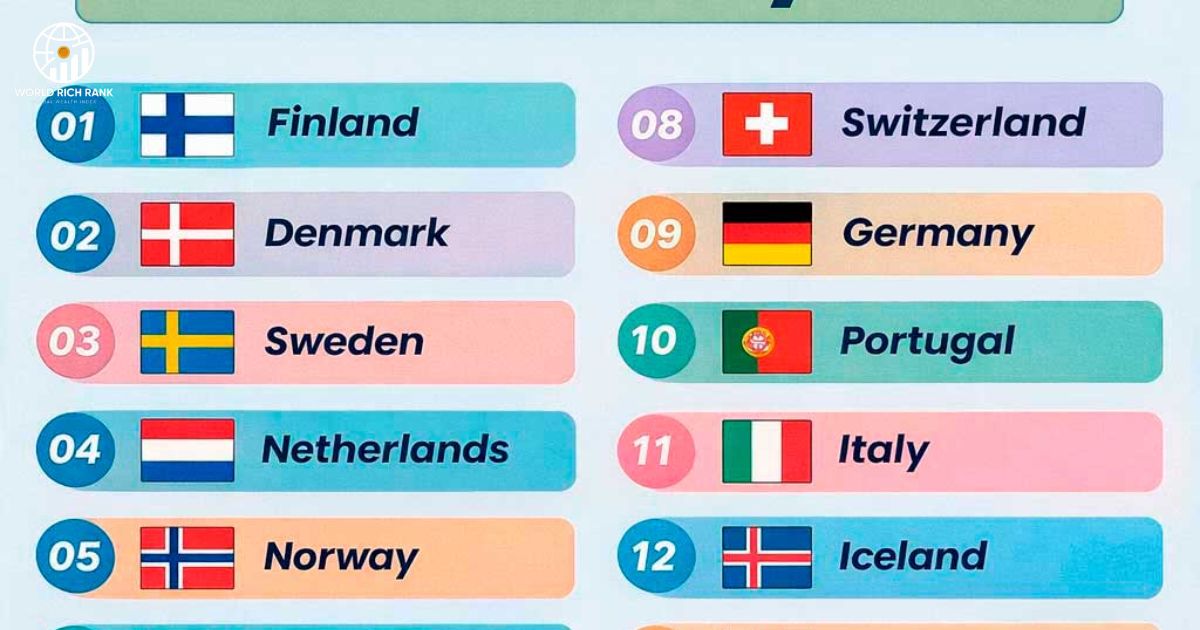
Comparative Snapshot of Key Family Metrics
The table below compares safety, happiness, parental leave, child well-being, and living costs across the 10 family-friendly countries.
| Country | Peace & Safety (GPI Rank) | Happiness Rank (WHR 2024) | Annual Parental Leave (approx. paid weeks) | Child Well-Being Rank (UNICEF) | Cost of Living Index (Numbeo) |
| Finland | #13 | #1 | ~60 weeks (shared) | #14* | ~69 |
| Denmark | #8 | #2 | ~52 weeks total (split parents) | #2 | ~79 |
| Sweden | #20 | #4 | ~68 weeks (480 days) | #10 | ~68 |
| Netherlands | #18 | #6 | ~16 weeks maternity + parental options | #1 | ~73 |
| Norway | #33 | #7 | ~49–59 weeks (flexible) | — | ~84 |
| Switzerland | #6 | #9 | 14 weeks maternity + 2 weeks paternity | #6 | ~111 |
| Canada | #11 | #15 | ~52 weeks (combined options) | #22 | ~69 |
| Australia | #19 | #10 | ~18 weeks (plus partner leave & options) | — | ~68 |
| New Zealand | #4 | #11 | ~26 weeks (paid) | — | ~60 |
| Austria | #3 | #14 | ~64 weeks (approx. 16 months, split) | #16 | ~71 |
*UNICEF’s latest 2025/2026 comparisons differ from some older rankings; the current report places Finland at #14, while Netherlands and Denmark remain the top two.
Sources: Global Peace Index 2024, World Happiness Report 2024, UNICEF Innocenti child well-being reports, and Numbeo cost-of-living data. The happiness rankings are based on life evaluations, while UNICEF’s ranking combines children’s mental well-being, physical health, and skills.
These figures should be treated as comparative indicators rather than a single definitive family ranking. Parental-leave entitlements can also vary according to employment status, income, and how leave is divided between parents.
Safest Countries for Families (Peace & Security)
For families, safety means more than low crime; it also includes political stability, social security, peaceful communities, and reliable public institutions. In the 2026 Global Peace Index, several countries in this list perform exceptionally well, including New Zealand, Switzerland, Austria, Finland, Denmark, Canada, the Netherlands, and Australia.
New Zealand ranks 2nd globally in the 2026 GPI, while Switzerland ranks 3rd and Austria 6th, making them particularly strong choices for parents who prioritize stability and personal security. Finland ranks 9th, Denmark 11th, Canada 14th, the Netherlands 17th, and Australia 20th. Sweden and Norway remain peaceful by international standards, although their overall GPI positions are lower than some of the other countries in this group.
For children, a peaceful environment can support greater independence and outdoor activity. Safe neighborhoods, dependable transportation, stable schools, and accessible public services can make everyday family life easier. Countries such as Denmark, Finland, Sweden, and the Netherlands are also known for community-oriented infrastructure and child-friendly public spaces, while New Zealand, Norway, and Austria offer extensive access to nature and outdoor recreation.
However, families should not judge safety from a single ranking. The GPI measures peacefulness using 23 indicators across societal safety and security, ongoing conflict, and militarization, rather than measuring everyday family conditions alone. When choosing where to live, parents should also consider local crime rates, healthcare, schools, housing, transportation, and the safety of the particular city or neighborhood.
Most Affordable Countries to Raise a Family
Affordability is an important part of choosing a family-friendly country because parents need to balance housing, food, childcare, healthcare, education, transportation, and everyday expenses. A country does not have to be the cheapest place to live to offer good value for families. The better choice is often a destination where reasonable living costs are combined with safe communities, quality public services, good schools, and a comfortable lifestyle. Portugal, Spain, several Eastern European countries, and Costa Rica stand out as options worth considering in 2026.
Portugal
Portugal remains attractive to families looking for a relatively affordable European lifestyle. Compared with many major Western European destinations, housing, dining, transportation, and everyday services can be more manageable, particularly outside Lisbon and the most expensive coastal areas. Smaller cities and inland communities can provide better value for families who do not need to live in the country’s most popular tourist locations.
Housing is usually the largest expense for a family, so choosing the right location can make a substantial difference. Cities such as Braga, Coimbra, Aveiro, and parts of northern Portugal may offer lower costs than central Lisbon. Families can also benefit from Portugal’s public healthcare system and state education, while international schools are available for parents who prefer English-language or other international curricula.
Portugal also provides a relaxed lifestyle that appeals to families. Mild weather allows children to spend considerable time outdoors, while beaches, parks, historic towns, and recreational areas provide inexpensive opportunities for family activities. Portuguese communities are generally welcoming, and the country’s established international population can make the transition easier for newcomers.
The main drawback is that housing costs have increased considerably in popular areas. Families should therefore compare rent, school expenses, transportation, and salaries rather than assuming the entire country has the same affordability level. For families with remote income or savings, Portugal can offer particularly strong value because everyday expenses may be lower than in several Northern European countries.
Spain
Spain combines a comparatively affordable cost of living with extensive family amenities, making it another strong European option. Groceries, public transportation, restaurants, and many everyday services can be reasonably priced compared with countries such as Switzerland or Denmark. Housing varies significantly by location, with Madrid, Barcelona, and popular coastal destinations generally costing more than smaller inland cities.
Families seeking greater value can consider cities such as Valencia, Zaragoza, Alicante, Murcia, or Granada. These locations offer access to schools, healthcare facilities, parks, shopping, and public transportation without necessarily carrying the same housing costs found in Spain’s most expensive markets.
Spain’s lifestyle is another major advantage. Children can enjoy outdoor spaces, beaches, sports facilities, public squares, and a generally social community environment. The country’s healthcare system is also an important consideration for families, although eligibility and access depend on residency and individual circumstances.
Education is available through public and private systems, with international schools providing alternatives for expatriate families. Parents should research language requirements because regional languages, including Catalan, Basque, and Galician, can be relevant depending on where a family settles.
Spain is not uniformly cheap, and housing can be expensive in high-demand locations. Still, families who choose their city carefully can achieve a good balance between living costs, public services, climate, and quality of life. For parents who want European infrastructure without the highest Northern European expenses, Spain can be an appealing middle-ground choice.
Eastern Europe (e.g. Poland, Czech Republic, Slovenia)
Eastern and Central Europe can provide some of the strongest combinations of affordability and modern infrastructure for families. Poland, Czech Republic, and Slovenia are particularly interesting because they offer developed urban environments, good transportation networks, schools, healthcare facilities, and access to nature while generally costing less than Europe’s most expensive countries.
Poland can be attractive for families because major cities offer extensive services, employment opportunities, universities, shopping centers, parks, and public transportation. Warsaw and Kraków are more expensive than smaller cities, so families focused on reducing expenses may want to consider locations outside the largest urban centers.
The Czech Republic offers a similar balance. Prague is the country’s major international hub but has higher housing costs. Cities such as Brno, Ostrava, and Olomouc can provide alternatives with strong infrastructure and family amenities. Public transportation is particularly useful for households that want to limit car expenses.
Slovenia is smaller but offers a strong quality-of-life proposition. Ljubljana provides schools, healthcare, public transportation, parks, and cultural activities, while the country’s compact geography makes it easy to reach mountains, lakes, and other outdoor destinations. Housing costs can be higher in desirable areas, but families may still find good value compared with some Western European capitals.
One of the biggest advantages of this region is that affordability does not necessarily mean sacrificing modern conveniences. Families can find supermarkets, reliable transport, healthcare, educational institutions, recreational facilities, and well-connected cities. The trade-off can include colder winters, language barriers, and lower salaries for locally employed workers.
For families earning income from abroad, Eastern Europe can be especially appealing because lower everyday expenses can stretch an international salary further. However, parents moving for employment should compare local wages, taxes, housing, and childcare costs before making a decision.
Latin America (Costa Rica)
Costa Rica offers a different approach to affordable family living. Instead of European infrastructure and dense cities, families can choose a lifestyle centered around nature, outdoor activities, and relatively relaxed communities. The country is particularly attractive to parents who value warm weather, beaches, forests, and an active outdoor lifestyle.
The cost of living varies substantially by location. Popular expatriate areas and parts of the San José metropolitan region can be considerably more expensive than smaller towns. Families who choose locations carefully may reduce housing and daily expenses while still remaining within reach of schools, healthcare, shopping, and other essential services.
Costa Rica has both public and private healthcare options, while families can choose between public schools and private or international education depending on their needs. International schools can be an important consideration for expatriate families but may add significantly to the monthly budget.
Food can also be relatively affordable when families purchase locally produced goods and shop at local markets. Eating imported products and relying heavily on tourist-oriented businesses can increase expenses quickly. Transportation is another factor to consider, particularly for families living outside major urban areas.
Costa Rica’s greatest appeal may be the lifestyle rather than simply the price. Children can enjoy beaches, mountains, wildlife, hiking, and other outdoor experiences throughout the year. Parents should nevertheless research local safety, healthcare access, schooling, immigration requirements, and housing before choosing a specific community.
Overall, Portugal, Spain, Poland, Czech Republic, Slovenia, and Costa Rica demonstrate that affordable family living can take many forms. The best destination depends on whether a family prioritizes lower housing costs, education, healthcare, climate, outdoor activities, or access to major cities. Comparing the total household budget rather than focusing only on rent or grocery prices is the most reliable way to determine which country provides the best value in 2026.

Best Work-Life Balance & Parental Support
For families, work-life balance can be just as important as salary or housing costs. Parents need enough time away from work to care for children, attend school activities, manage household responsibilities, and enjoy family life. Countries such as Sweden, Denmark, Norway, Finland, the Netherlands, and Austria are particularly attractive because their social systems place strong emphasis on parental leave, childcare, flexible working arrangements, and family well-being.
Sweden is widely recognized for its generous parental leave system, which allows parents to share a large pool of paid leave after a child’s birth or adoption. The system gives families flexibility over how they use their available days, while subsidized childcare makes it easier for both parents to return to work. Sweden also promotes flexible working arrangements and generally places less emphasis on extremely long working hours.
Denmark combines strong parental benefits with a culture that values personal time. Parents can access parental leave and childcare support, while employees generally benefit from reasonable working hours and substantial vacation time. Affordable or subsidized childcare and reliable public services can reduce some of the everyday pressure on working parents. This makes Denmark particularly appealing to families where both parents want to maintain careers.
Norway also provides extensive support for parents through parental leave, childcare arrangements, and welfare benefits. Parents can generally choose between different leave options depending on their circumstances, giving households greater control over the first year of a child’s life. Norway’s emphasis on outdoor recreation also encourages families to spend time together away from work and school.
Finland offers another strong combination of family support and work-life balance. Parents benefit from parental leave arrangements, public childcare, healthcare, and education services. Finnish society also places considerable importance on children’s well-being and giving families time to maintain a healthy daily routine. Flexible arrangements can make it easier for parents to combine employment with childcare responsibilities.
The Netherlands is especially notable for its relatively balanced working culture. Part-time employment is common, allowing some parents to reduce working hours while remaining professionally active. Flexible schedules and parental leave options can help families organize work around school and childcare. Dutch cities also have excellent cycling and public transportation infrastructure, which can simplify everyday family routines.
Austria provides families with a combination of parental leave, childcare support, healthcare, and other social benefits. Its parental-leave system can allow parents to remain home for an extended period, while childcare options help support a gradual return to employment. Vienna and other Austrian cities also offer strong public transportation and family-oriented amenities.
Overall, the best countries for work-life balance are not necessarily those with the highest salaries. They are countries where parents can earn a living while still having meaningful time with their children. Sweden, Denmark, Norway, Finland, the Netherlands, and Austria stand out because parental support is combined with public services, flexible employment possibilities, and a broader culture that recognizes family time as an important part of a healthy life.
Education and Healthcare Excellence
Education and healthcare are two of the most important factors families consider when choosing where to live. A strong education system can give children better opportunities to learn and develop, while accessible healthcare helps parents manage routine checkups, vaccinations, emergencies, and long-term needs. Countries such as Finland, Denmark, Sweden, Norway, the Netherlands, Switzerland, Australia, and Austria combine strong public services with high living standards, making them attractive choices for families in 2026.
Education
Finland is particularly well known for its child-centered approach to education. Schools place emphasis on learning, creativity, problem-solving, and student well-being rather than relying entirely on high-pressure testing. Public education is widely accessible, while libraries and other community resources provide additional opportunities for children to learn outside the classroom.
Denmark, Sweden, and Norway also provide strong education systems supported by substantial public investment. Children can benefit from well-trained teachers, modern schools, extracurricular activities, and approaches that encourage independence and collaboration. These countries also generally place importance on creating supportive learning environments where children’s social and emotional development is considered alongside academic achievement.
The Netherlands, Switzerland, Australia, and Austria offer families a range of public, private, and international education options. This can be useful for expatriate families who may want English-language or international curricula. However, education quality and costs can differ between regions, so parents should compare individual schools, admission requirements, language policies, and tuition before choosing a city.
Healthcare
Healthcare is another major consideration when raising children abroad. Families need reliable access to pediatric care, vaccinations, routine examinations, emergency treatment, dental services, and specialist healthcare when necessary. The countries on this list generally have developed healthcare systems, although the way services are funded and accessed differs from one country to another.
Sweden, Denmark, Finland, and Norway rely heavily on publicly supported healthcare systems. Residents can generally access primary and specialist medical services through established public networks, while children benefit from preventive healthcare and vaccination programs. Public funding helps reduce the financial burden of many essential services, although waiting times and eligibility rules can vary.
The Netherlands uses a regulated health insurance system in which residents are generally required to have basic health insurance. This provides broad access to medical care while allowing patients to use a structured network of healthcare providers. Families should account for insurance premiums and other out-of-pocket costs when preparing their household budget.
Switzerland has an excellent healthcare system and modern medical facilities, but healthcare is considerably more expensive than in many other family-friendly countries. Mandatory health insurance means families need to include premiums, deductibles, and other potential expenses in their financial planning. The high cost can be a disadvantage, particularly for larger families.
Australia provides access to Medicare for eligible residents, alongside private healthcare options. Families can use public hospitals and medical services, while private insurance may provide additional choices or help with certain expenses. Healthcare access is generally strong in major cities, although families living in remote areas may have fewer specialist services nearby.
Austria also offers comprehensive healthcare supported through social insurance and public medical services. Families benefit from access to doctors, hospitals, preventive care, and specialist treatment. For parents comparing countries, however, it is important to look beyond the reputation of a healthcare system and consider eligibility, insurance arrangements, waiting times, availability of pediatric specialists, and healthcare costs in the specific area where they plan to live.
How to Choose the Right Country for Your Family
Choosing the best country for your family requires more than looking at rankings or comparing average living costs. A country that works well for one household may not suit another because children’s ages, income, career goals, education preferences, and lifestyle needs can be very different. Before making a decision, families should look at both the country’s overall quality of life and the practical realities of living in a particular city or region.
List your must-haves:
Start by identifying the factors that matter most to your household. These might include safe neighborhoods, good schools, affordable healthcare, childcare, parental leave, employment opportunities, public transportation, or access to nature. Separating essential requirements from preferences makes it easier to eliminate countries that do not fit your family’s needs.
Research visa/residency options:
A country may look perfect but still be difficult to move to permanently. Research the visa and residency routes available to your entire family, including work, skilled-worker, student, family, digital-nomad, or other residence options. Check income requirements, health insurance rules, renewal conditions, family sponsorship, and the potential path toward permanent residency or citizenship.
Consider climate and culture:
Climate can have a major effect on everyday family life. Some families prefer warm weather and outdoor activities, while others enjoy cooler temperatures and distinct seasons. Culture is equally important. Consider language, food, social customs, attitudes toward children, religious and cultural diversity, and how easily your family may adapt to local life.
Look at specific city/region:
National averages can hide major differences between cities. Housing, schools, salaries, transportation, and childcare may vary significantly within the same country. Compare several locations instead of choosing a country first and a city later. A smaller city may provide cheaper housing and a quieter environment, while a major city may offer better employment and international-school options.
Calculate the finances:
Create a realistic monthly family budget before moving. Include rent or mortgage payments, groceries, utilities, transportation, childcare, school fees, healthcare or insurance, taxes, entertainment, and unexpected expenses. Also compare your expected income with local costs. A country with inexpensive groceries may still be unaffordable if housing or childcare is expensive.
Community and support:
Finally, consider whether your family will have access to a supportive community. Friends, relatives, international communities, schools, parent groups, and local activities can make settling into a new country much easier. A welcoming environment can be particularly valuable for children as they make friends and adapt to a new language or culture.
The best family-friendly country is ultimately the one that matches your priorities, budget, immigration situation, and preferred lifestyle. Taking time to compare these factors can help families choose a destination that works not only for the first few months but also for their long-term future.
Conclusion: Thriving as a Family in 2026
Choosing the right country for your family in 2026 is ultimately about finding a balance between safety, education, healthcare, affordability, and quality of life. Countries such as Sweden, Denmark, Finland, Norway, the Netherlands, Canada, Australia, New Zealand, Switzerland, and Austria offer different combinations of these advantages. Some stand out for parental support and work-life balance, while others provide excellent education, healthcare, outdoor opportunities, or stable communities.
Families should remember that there is no single destination that is perfect for everyone. A country with excellent public services may have higher taxes or housing costs, while a more affordable destination may offer fewer employment opportunities or require greater adjustment to language and culture. Looking beyond national rankings and comparing individual cities, neighborhoods, schools, healthcare access, and everyday expenses can lead to a much better decision.
The most successful move is one based on realistic expectations and careful preparation. Parents should confirm visa and residency requirements, create a detailed household budget, research schools and healthcare, and consider how children will adapt to the local environment. It is also important to think about long-term goals, including employment, permanent residency, citizenship, and opportunities for children as they grow.
In 2026, families have a wide range of destinations to consider, from highly developed Nordic countries to affordable European and international alternatives. By matching a country’s strengths with your family’s priorities and financial situation, you can find a place where children can grow safely, parents can maintain a healthy work-life balance, and the whole family can build a fulfilling future.
Frequently Asked Questions
What is the best country to raise a family in 2026?
There is no single best country for every family. Finland, Denmark, Sweden, Norway, and the Netherlands are among the strongest choices because they combine safety, quality education, healthcare, parental support, and a good work-life balance. The best option depends on your budget, career plans, children’s needs, and preferred lifestyle.
Why are Nordic countries ideal for families?
Nordic countries are known for strong public services, generous parental leave, accessible healthcare, quality education, and family-friendly social policies. They also tend to provide safe communities, outdoor spaces, and work environments that give parents more time with their children.
Which countries have the best education systems?
Finland, Denmark, Sweden, the Netherlands, Switzerland, Australia, and Austria are well regarded for education and child development. Finland is particularly recognized for its student-focused approach, while other countries offer a combination of strong public schools, vocational education, universities, and international-school options.
How does the United States compare?
The United States offers excellent universities, diverse communities, strong career opportunities, and high-quality healthcare and education options in many areas. However, families may face higher childcare, healthcare, and housing costs, while parental leave and public family benefits can be less extensive than those available in several European countries.
Are English-speaking countries good for families?
Yes. Canada, Australia, and New Zealand can be excellent choices for families, particularly for those who value English-language education, multicultural communities, outdoor activities, and strong employment opportunities. However, parents should compare housing, childcare, healthcare, school quality, and immigration requirements because costs and services vary considerably between cities and regions.

Stoke is a passionate writer and researcher focused on the world’s richest countries, global wealth, economies, and country rankings. He creates clear, easy-to-understand content to help readers explore global economic trends.